
Executive Summary
Electric grid planners have always had to make decisions under uncertainty, but in today’s planning context, uncertainty is at a renewed high. Planners face deep uncertainty surrounding load growth, as well as surrounding the cost and availability of future resources, to name just two key sources of uncertainty. Thus, it is more important than ever for planners to develop portfolios that are flexible and adaptable, and that do well across a wide range of possible futures.
Planners are acutely aware of the need to manage uncertainty, but many planning processes in use today fall behind best practices in terms of treatment of uncertainty, despite significant methodological advances in recent years. In many jurisdictions, it is common to use simple deterministic optimization with scenarios, a method which has the potential to leave planners underprepared for future changes, and often “over-optimized” to decision-makers’ best guesses for how the future might play out. In this context, this paper aims to provide a framework for thinking about uncertainty management in resource planning in the modern context, as well as an overview of several key methods for developing portfolios that are robust to uncertainty, as well as flexible and adaptable.
This paper centers scenario analysis as a framework for thinking about making decisions under uncertainty. Scenario analysis implemented properly consists of two steps: 1) develop decision options, and 2) test them across many scenarios. This framework separates out decisions that must be made in the near term, the “here-and-now” decisions, from decisions that can be made later, the “wait-and-see” decisions, and helps decision-makers identify “here-and-now” decisions that perform well across many possible futures. This is fundamentally different from deterministic optimization with scenarios, an all-too-common planning methodology which can give the appearance of addressing uncertainty, while missing the crucial step of testing the performance of decisions across many possible futures.
Within the framework of scenario analysis, this paper introduces four methods for developing portfolios that are robust and adaptable in the face of uncertainty: 1) deterministic optimization, 2) heuristics, 3) stochastic optimization, and 4) robust optimization. Stochastic and robust optimization can be particularly helpful in identifying robust and adaptable portfolios amidst a large decision space, although they introduce additional complexity in the form of needing to identify and quantify key uncertainties, and can sometimes be limited by computational constraints. We also review some key considerations when it comes to interpreting the results of a scenario analysis framework.
This paper discusses several key planning entities that have implemented the frameworks described, highlighting that the barriers to implementation of these methods are “soft,” not technical. Ease-of-use of software and computational constraints are key barriers to implementation, but these barriers are rapidly shifting with the development of new software and methods. This paper aims to support an increased understanding of these methods so that, together with the widespread availability of software tools, planners can make robust and flexible decisions in the face of uncertainty, saving ratepayers money in the long term while avoiding the risk of key downsides such as stranded assets.
Introduction
Electric grid planners and their regulators are increasingly making decisions about infrastructure amidst growing tensions: they must ensure the grid is prepared for potential load growth and can meet decarbonization targets, while also addressing growing concerns about affordability and facing deep uncertainty over grid needs. They must plan for changes, but the changes are uncertain—and both under- and over-investment have ratepayer cost consequences that could threaten affordability. Electricity planning was always hard, but today, amidst deep uncertainty and affordability concerns, planning is harder than ever.
At the core of this challenge is how to manage uncertainty. Planners have always had to manage uncertainty—in particular, planners are accustomed to ensuring generation capacity is sufficient to meet peak demand with a high probability, and they also are accustomed to managing factors such as fuel price risk. In today’s context, however, planners face more uncertainty than ever before. Load is highly uncertain due to uncertain data center load growth, electrification loads, and climate-driven demand changes. The availability and cost of future energy technologies is highly uncertain due to a rapidly changing technological landscape, and uncertain tax credits, tariffs, and siting constraints. And the rapidly changing state of the grid means that import availability and generator retirement schedules are increasingly uncertain.
Though many jurisdictions have done a good job at uncertainty management with the tools available to them, as will be highlighted in this paper, it is all too common for planners to use simple deterministic optimization to make decisions, a method which has serious shortcomings. At the same time, the computational capabilities of planning models have grown immensely over the last decade, and industry has shown increasing interest in advanced analytical techniques for managing uncertainty, as evidenced by events such as the Probabilistic Planning Symposium hosted by MISO in 2024.1 This push has been aided by academic research, which has produced a plethora of ideas for grid planning under uncertainty, as evidenced by the hundreds of papers published over the last two decades on topics such as stochastic optimization applied to grid planning and operations. Despite these advances, modern techniques for uncertainty management in grid planning, such as stochastic optimization, have rarely been adopted in practice.
In this context, there is a need for a better framework for planners to use in understanding how to comprehensively manage uncertainty. With billions of dollars of investment at stake, this problem is more important than ever, both for affordability-concerned parties such as ratepayers, advocates, and regulators, and for utilities hoping to avoid stranded assets.
This paper aims to address this need by providing a comprehensive overview of methods for uncertainty management in electric grid planning. After a short section demonstrating the importance of using techniques for planning under uncertainty, we will begin by offering a framework for thinking about planning under uncertainty that all grid planners can adopt even with current commercially available tools, and that many jurisdictions already use. We will then provide an overview of recent methodological advances that allow for even more advanced uncertainty management, leveraging recent advances in computational power. Following these core sections, we will lay out specific roles for key entities involved in the planning process, highlight ways to measure success, and elucidate key gaps and barriers to implementation.
The Cost of Ignoring Uncertainty
While most, if not all, grid planners recognize that uncertainty is important to consider in planning, many do not recognize the pitfalls of one of the more commonly used methods for incorporating uncertainty: deterministic optimization with scenarios. In this section, we illustrate these pitfalls, beginning with an intuitive example, and use the discussion to motivate the need for the uncertainty management framework discussed in the next section.
Deterministic optimization in the context of grid planning generally consists of using a capacity expansion model to identify optimal grid infrastructure investments and running this model for multiple different scenarios. While this process can give the appearance of addressing uncertainty, it has a serious shortcoming: each model run only tells decision-makers what would be optimal if the future is known with perfect certainty, for a given scenario, and there is no consideration of the performance of portfolios if the future deviates from these expectations. In short, portfolios developed with this method can commonly be “over-optimized” to the scenario that was used to design them. Planners sometimes address this limitation by picking investments that show up in multiple scenarios, which is a step in the right direction (and is an example of the “heuristic” framework discussed in subsequent sections). However, even this methodology does not, by itself, explicitly address the performance of portfolios under an uncertain future, which is a critical piece of a strong uncertainty management framework. This idea of over-optimization is illustrated in Box 1.
In Box 1, if the planners in question had optimized for only one scenario at a time, they would have not identified that the Geothermal plant was the lowest-risk investment option. This illustrates how modeling only deterministic scenarios can lead to over-optimization, and much higher costs for ratepayers, should the future turn out differently from what we expect. But how much of a difference do these factors make in the real world? Several recent studies2 suggest that in the context of a regional grid such as WECC (the Western US grid), better uncertainty management methods for transmission planning could save ratepayers tens of billions of dollars in the long run—the same order of magnitude as the cost of one or several large transmission lines themselves. The intuition for this result is two-fold: on the one hand, if we build transmission from supply-heavy regions where resources do not end up showing up or to demand-heavy regions where demand is less than expected, we are left with stranded assets, and higher costs than expected. On the other hand, if we don’t build enough transmission to connect resources to load, then our upfront costs are lower, but we can also end up with much higher costs in the long run due to high curtailment, potential outages, and a higher potential for market power by developers who have secured scarce interconnection rights. Better uncertainty management techniques address this problem by helping decision-makers select transmission projects that work well across a wide range of these future scenarios, making sure to balance multiple kinds of downside risks. For example, a better decision might be to invest in a “backbone” line for transmitting power from a resource-heavy region to a load-heavy region—while waiting to develop spur lines until more certainty on resources and loads is obtained.
A key finding of these studies that generalizes beyond just transmission planning is that better uncertainty management techniques can help to identify investments that are flexible and do well across a wide range of possible futures– avoiding potential large downsides and stranded assets.
Scenario Analysis as a Framework
There are many complex methodologies for managing uncertainty in grid planning, which we will review below, but more important than any one methodology is the proper application of a framework for managing uncertainty. Scenario analysis provides this framework, and in this context, the methods described below fit into different parts of the framework. This may sound obvious, but very often, scenarios are used in planning without being properly applied to a scenario analysis framework, so we believe it is worth laying out how scenario analysis should work.
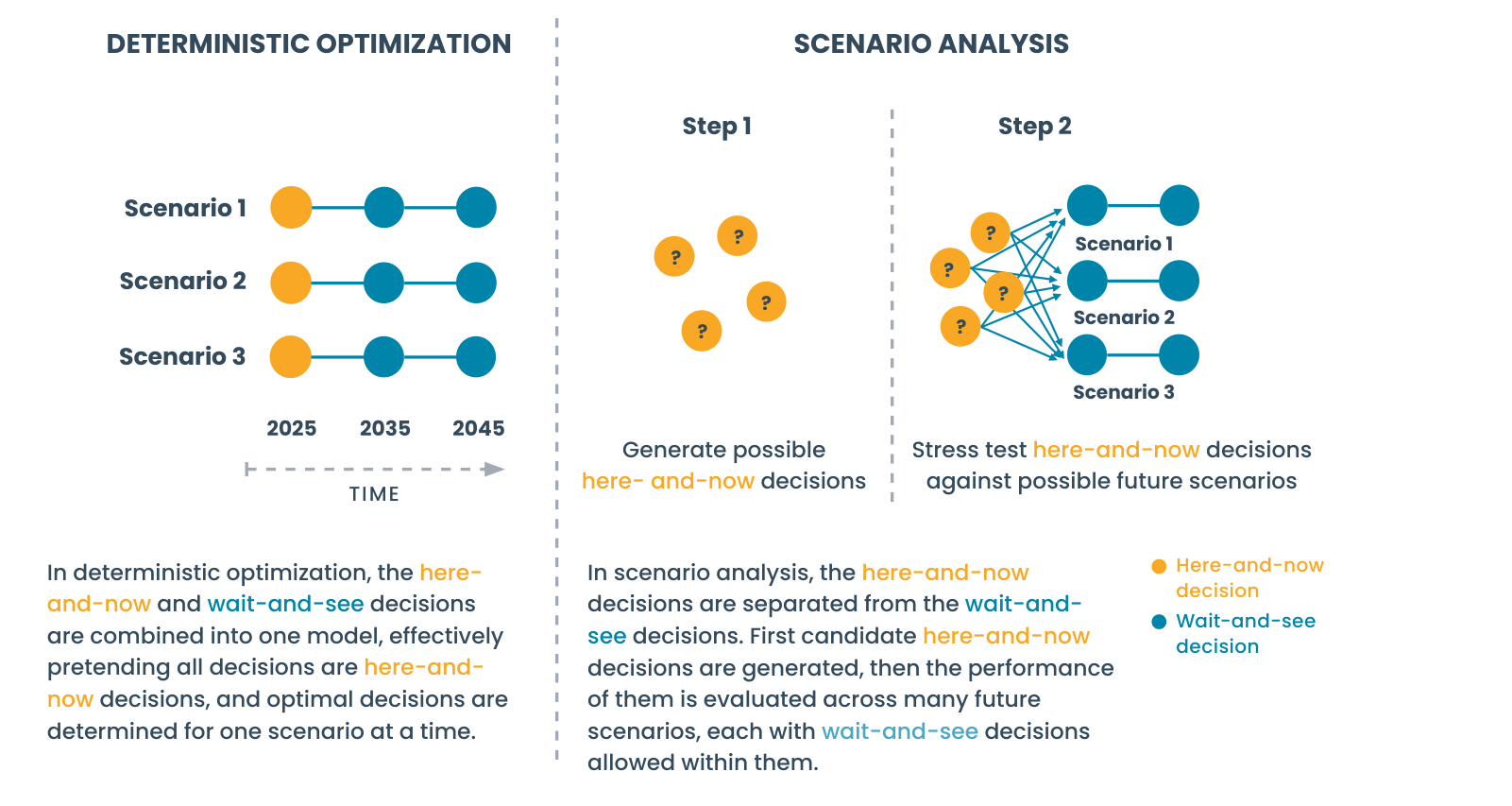
Scenario analysis has two steps: 1) develop decision options, and 2) test them across many scenarios. The goal of this process is to identify decisions that do well across a range of possible scenarios for how the future might play out. This is fundamentally different from deterministic optimization with scenarios, in which these two steps are combined–by finding optimal decisions for only one scenario at a time, without examining the performance of decisions across multiple possible futures.
In the first step, “develop decision options,” planners identify a range of possible portfolios to evaluate. These could be determined via capacity expansion modeling, or they could be determined some other way. Ideally, the range of portfolios should span a wide range of possible resource decisions. In the second step, where candidate decisions are tested across scenarios, planners assess the performance of the candidate portfolios across a wide range of possible futures, with the goal of identifying portfolios that are “robust,” meaning they do well across a wide range of scenarios.
The simplicity of this framework means that utilities and grid planners can adopt it today, with currently available software. Many utilities and transmission planners already adopt such a framework in their planning processes, as will be detailed more in subsequent sections. However, all too often, planners will simply model deterministic scenarios, rather than performing the two-step process described here. The difference between these two approaches is illustrated in Figure 1. As the figure illustrates, a key distinguishing feature of scenario analysis done properly is that the “here-and-now” decisions– decisions which must be made in the near term– are identified and broken out from the “wait-and-see” decisions, which are decisions that can be made later. In deterministic optimization, this distinction is not made, and the model simply tells planners what decisions to make between now and the end of the modeling horizon, assuming we know the future with perfect certainty. This can be a helpful methodology for generating possible near-term decisions, as will be detailed in the following sections, but it does not suffice for an uncertainty management methodology, as it tells you nothing about what happens if the future is different from what we expect.
For the interested reader, a recent GridLab publication, “Rethinking the Role of Capacity Expansion Modeling,” also describes a similar framework for scenario analysis, and goes into more detail on one potential method for generating and evaluating candidate portfolios.3
It is also important to note that designing portfolios to account for weather-driven or other operational uncertainties such as generator forced outages is best handled with existing methods that are commonly implemented in capacity expansion modeling and resource adequacy assessment frameworks, such as a) representative periods4 and b) reserve margins with capacity accreditations. These methods together allow planners to develop portfolios that perform well in the face of weather-driven uncertainties in generator availability. In recent years it has become more common to have an iterative process between capacity expansion and resource adequacy assessment steps (sometimes called “round-trip” modeling).5 The methods described in the current paper are intended to be applied to other, more macro-scale uncertainties, such as fuel prices, macro-scale load growth, and future resource cost and availability—the same uncertainties that are commonly represented using deterministic scenarios in planning frameworks. These methods (in the current paper) could also be applied to manage climate-driven uncertainty in future weather, which is a domain that current frameworks for managing weather-driven uncertainty are not designed to handle.
Methods for Robust Portfolio Development
Within the first step of the scenario analysis framework, there are many possible methods for generating possible here-and-now decisions. Some are more basic, and some leverage advances in computational methods to help planners develop more robust, flexible portfolios. In this section we describe four of these approaches: deterministic optimization, heuristics, stochastic optimization, and robust optimization.
Deterministic optimization
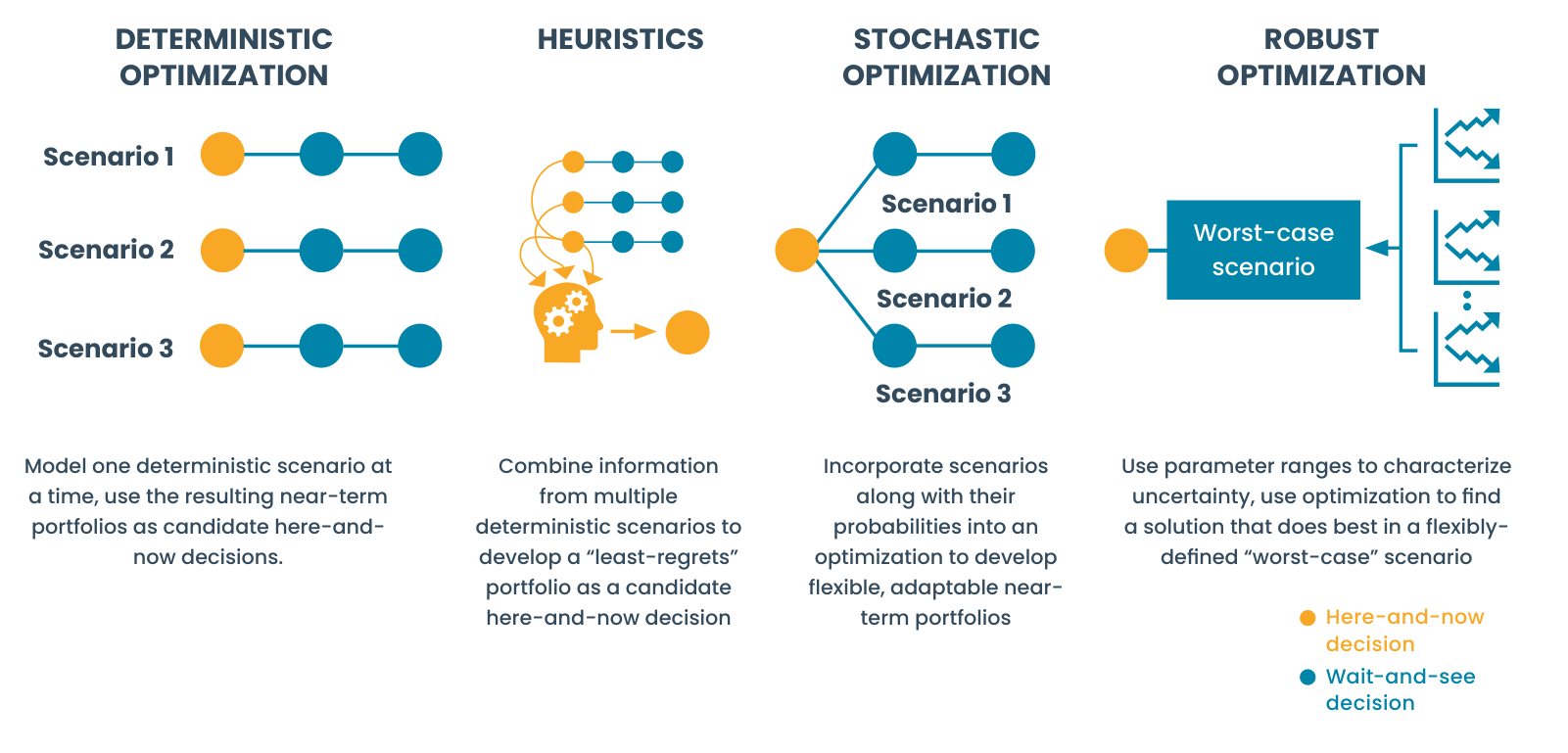
While the method of deterministic optimization with scenarios described above is not sufficient as an uncertainty management framework on its own, it can be helpful for generating candidate near-term decisions. Deterministic capacity expansion can be run for multiple scenarios of how the future might play out, and then the relevant here-and-now decisions can be taken as candidate portfolios. We intentionally keep this section brief given this methodology has already been described. The figure below details some pros and cons of deterministic optimization as a robust portfolio development tool.
| Pros | Cons |
|---|---|
| Simple to implement; can use existing models; computational simplicity | Portfolios that are flexible and adaptable may be missed, as the model has no reason to select them for any one scenario |
| Helps generate a range of near-term decisions via deterministic scenarios | Can have the appearance of sufficing for an uncertainty management framework in and of itself |
Heuristics
A more advanced methodology for developing candidate here-and-now decisions is to use heuristics to come up with portfolios based on information from scenario modeling. For example, one could use the heuristic “select only resources that show up in all scenarios,” or “select resources that show up in at least two scenarios,” to come up with candidate near-term decisions. This is a heuristic way of developing “least-regrets” near-term portfolio decisions, because the resulting portfolio resources are likely to be needed across multiple possible futures. This methodology is also commonly used as it does not require advanced modeling methods. One example is ENTSO-E’s long-term transmission planning effort, detailed in Case Study 1 below.
The figure below details some pros and cons of the heuristic approach to portfolio development.
| Pros | Cons |
|---|---|
| Simple to implement; can use existing models; computational simplicity | Can still miss flexible investment options that are not shown as optimal in any one scenario |
| Likely to identify least-regrets investments that are needed in many possible futures | Results are likely to be conservatively biased towards under-investment |
Stochastic optimization
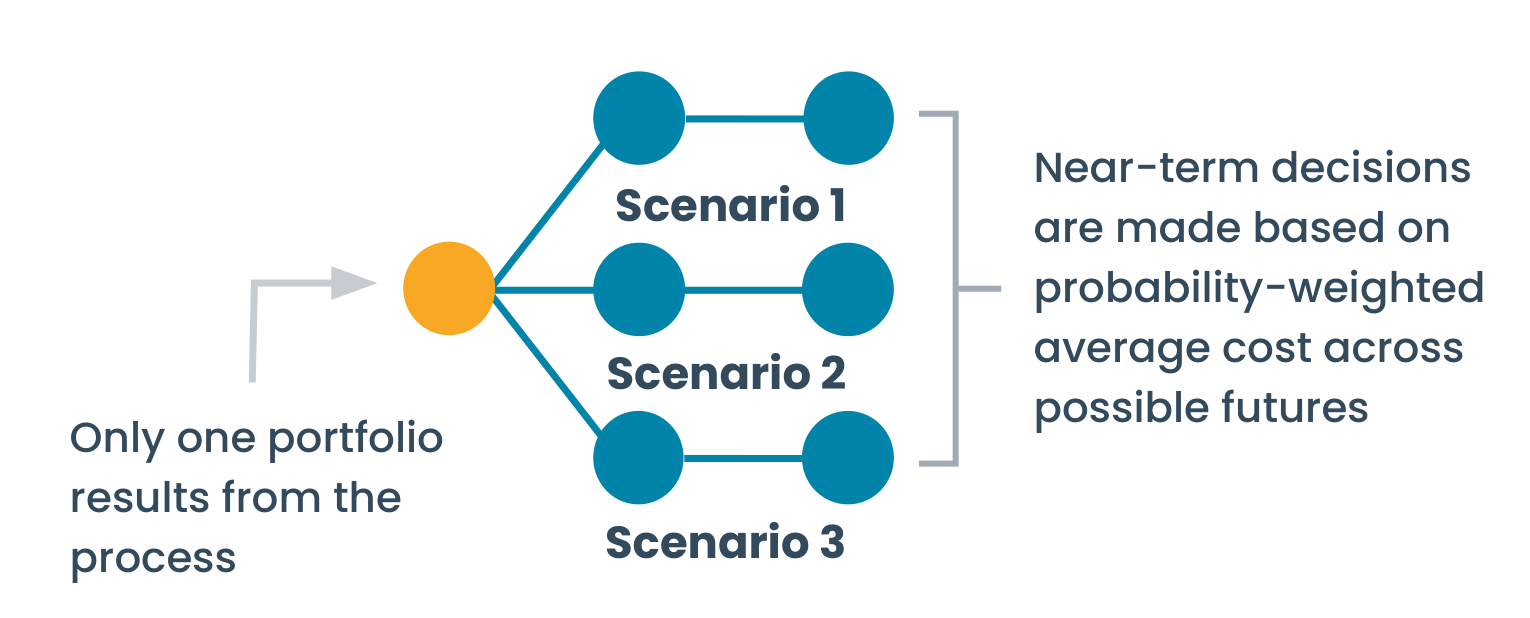
Stochastic optimization is a method that uses optimization to find near-term decisions that work well across a range of possible futures. To do this, it endogenously incorporates multiple possible future scenarios into an optimization model, and defines an optimal portfolio as one that does the best on average across all the scenarios. Thus, a stochastic optimization model explicitly helps decision makers find decisions that are flexible and adaptable, and that do well across a range of future scenarios. This is most helpful when the decision space is large, meaning these flexible and adaptable decisions might be missed by other portfolio generation methods.
To find an optimal portfolio that does the best on average, a stochastic optimization model must have some definition of what “average” means. Therefore, it requires assigning probabilities to future scenarios, which are used to define a probability-weighted average, known as an “expected value.” This expected value, across scenarios, is what is optimized for in stochastic optimization. This is fundamentally different from deterministic optimization, in which only one scenario is optimized for at a time. Expected value is a common mathematical term, but in reality “probability-weighted average” is a better description of what is being optimized for: when the future is uncertain, nothing can be “expected.” In stochastic optimization models, risk aversion on the part of the decision maker can also be included, in order to help find portfolios that minimize “downside” risk, or performance if things go worse than expected.
The need to assign probabilities when developing a stochastic optimization model can be a barrier to implementation, given that often, there is not a solid basis on which to assign probabilities. For example, planners may want to examine fuel price uncertainty as a key uncertainty source, but past fuel price probability distributions are unlikely to be a solid basis for the distribution of future fuel prices.
Crucially, even though stochastic optimization inherently considers multiple scenarios for how the future could play out, the result is one portfolio for optimal near-term decisions. This is in contrast to deterministic optimization with scenarios, which generates multiple near-term decision options. However, to create multiple portfolio options to compare in the stress-testing stage of scenario analysis, modelers can vary scenario probabilities or adjust risk aversion parameters. Modelers can also use other robust portfolio development methods described in this section to come up with multiple portfolios to compare to a portfolio generated with stochastic optimization. Figure 2 illustrates how stochastic optimization works, and Case Study 2 provides a real-world example.
Robust optimization
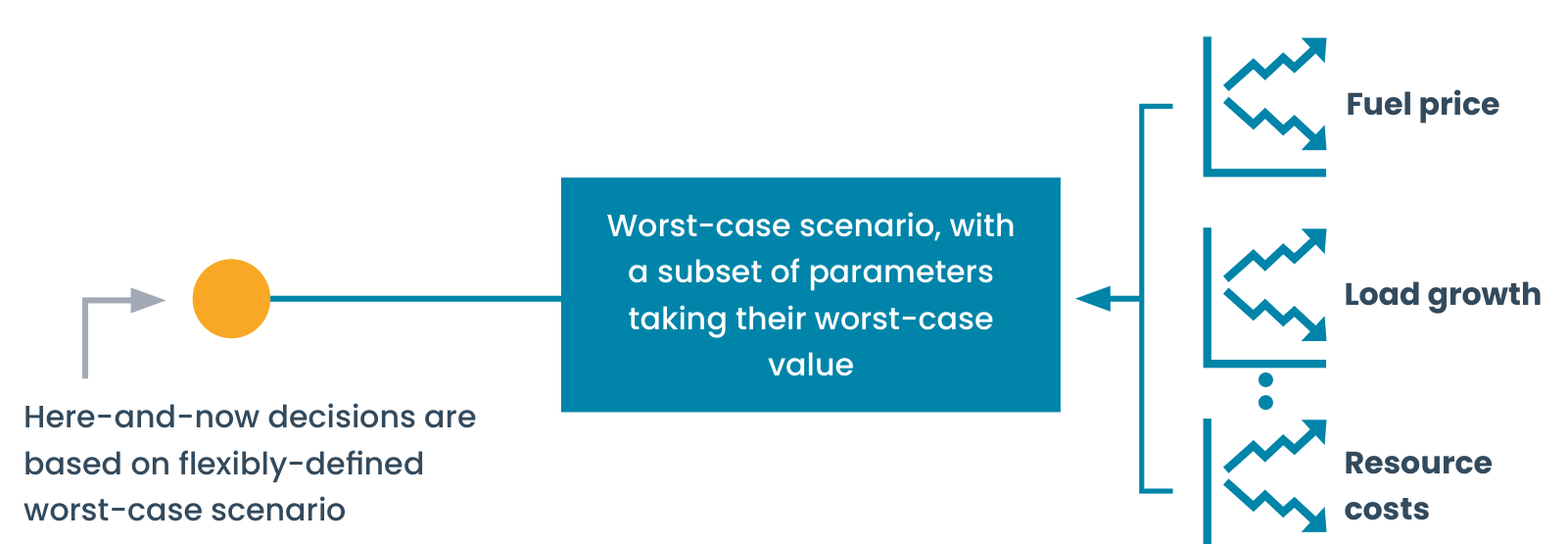
Robust optimization is similar to stochastic optimization in that it is a modeling technique for finding portfolios that are flexible and adaptable, and that do well across a wide range of possible futures. In robust optimization, rather than defining scenarios and assigning scenario probabilities as in stochastic optimization, uncertainty is characterized by assigning a range of possible values that uncertain parameters could take. This is worth repeating: instead of scenarios, robust optimization uses parameter ranges to characterize uncertainty. For example, a system planner could assign a range of fuel prices, a range of future technology costs, or a range of load forecasts. To find an optimal portfolio, the model then finds the portfolio that does best in a “worst-case” scenario, where “worst-case” is flexibly defined to allow for varying levels of conservativeness. For example, the worst case could be defined as two uncertain parameters taking their worst-case value at the same time, or it could be defined as ten uncertain parameters taking their worst-case value at the same time. The higher this number, the more conservative the resulting portfolio.
The key insight behind robust optimization comes from the fact that the “worst case” is very unlikely to include all uncertain parameters taking their worst-case value at the same time, if they are mostly uncorrelated. Therefore, planners can significantly increase their preparedness for an uncertain future by planning for only a subset of things to go wrong– say, by planning for only 3 uncertain parameters to take their worst-case value at the same time. This means that, often, a large amount of “robustness” can be achieved with a relatively small amount of added near-term cost.
This worst-case framing is where the terminology “robust” comes from: the resulting portfolio is designed to be robust to downside risks, meaning scenarios where things go worse than expected. The added robustness can be thought of as an insurance policy: the resulting portfolio is often slightly more expensive in capital costs relative to a deterministic case—the insurance premium—but is designed to avoid scenarios where the long-term cost is much higher than expected. Figure 3 illustrates how robust optimization works in the context of resource planning.
One important, but subtle and under-appreciated, caveat of robust optimization is that it is not the same as taking the applicable worst-case scenario, even if it is known, and optimizing for that scenario deterministically. This is because if one were to optimize for that scenario, the model would be likely to “over-optimize” to that scenario, thus potentially creating a new worst-case scenario from different parameters going wrong. Therefore, robust optimization should be thought of as “finding a solution that does best in the worst case,” not just “optimizing for the worst case.”
An important advantage of robust optimization is that it does not require the assignment of probabilities, as does stochastic optimization. However, it does require the assignment of parameter ranges, and level of conservativeness, which like probability assignment can involve subjective judgment. A second advantage of robust optimization is that it can be much more computationally tractable than stochastic optimization, since all future scenarios do not need to be modeled at the same time. In particular, robust optimization for future resource and fuel costs (or other cost-based uncertainties) is highly computationally tractable and does not require major increases in computational power relative to deterministic optimization, although this functionality is not yet widely commercially available in planning tools.
It is important to note that, although stochastic optimization is generally characterized via scenarios with probabilities and robust optimization is generally characterized via ranges that uncertain parameters can take, robust optimization can also be performed with the aid of scenarios, which can ease the computational burden for certain very large problems. The distinguishing factor between the two methods is the presence of probabilities: stochastic planning always involves assigning probabilities to scenarios, whereas robust planning uses parameter ranges instead of probabilities.
Putting it all together
We conclude this section with the following figure to summarize the approaches to portfolio development discussed in this section:
Methods for Portfolio Analysis and Stress-Testing
The second step in the scenario analysis framework is to test candidate “here-and-now” decisions against possible scenarios for how the future could play out. In the context of resource planning, there are two main methods for doing this: production cost modeling, which tests operational performance of portfolios amongst varied weather conditions and fuel prices, and capacity expansion modeling, which both tests operational performance for a more limited set of operational periods, and allows for consideration of future capacity decisions in response to realization of uncertainty. Which method is used will depend on the pertinent uncertainties, and the level of adaptability required: if uncertainties related to future resource fixed cost and availabilities are important, and if modelers want to consider future capacity decision adaptations in response to these uncertainties, then a capacity expansion model is the right tool for the portfolio analysis step. (Production cost modeling can also be used in addition to capacity expansion modeling in this context.) It is important to remember that, in this use of capacity expansion modeling, the “here-and-now” decisions are fixed, and the capacity expansion model is only capturing future capacity decisions beyond the current decision horizon.
Regardless of the methodology used, the general idea of this step is the same: for each candidate “here-and-now” decision (e.g., a portfolio of resources in the context of IRP), fix this near-term decision to be constant, and evaluate the future cost of the candidate decision in each scenario.
The stress-testing step of scenario analysis can be overwhelming because it generates a lot of data: the performance of every candidate portfolio, in every possible scenario for how the future could play out. Thus, there are two important considerations in this step: how to view and consolidate the stress-testing data, and how to make decisions given the data.
Consolidating stress-testing results
There are two broad-strokes methods for consolidating the results of the stress-testing step: 1) using graphics and metrics to examine the performance of the candidate portfolios across scenarios, and 2) using probabilities of scenarios to perform a stochastic analysis.
The first option, using graphics and metrics to examine the performance of candidate portfolios across scenarios, is relatively straightforward but involves analysts needing to look at and consolidate a large amount of data. Often, bar graphs are compiled showing the cost of the candidate portfolios across the future scenarios. When bar graphs are not sufficient to show the full set of outputs, modelers can use summary metrics such as variability of portfolio performance across the scenarios, or performance at or beyond some high percentile of cost outcomes.
One example of this method is again from the 2019 PGE IRP, in which all candidate portfolios are evaluated against several key scenarios, including the “GHG-Constrained” future in which a future GHG constraint is introduced, affecting operations and future capacity decision making, and the “High Tech” future in which deployment of clean technologies is cheaper and more rapid than expected:
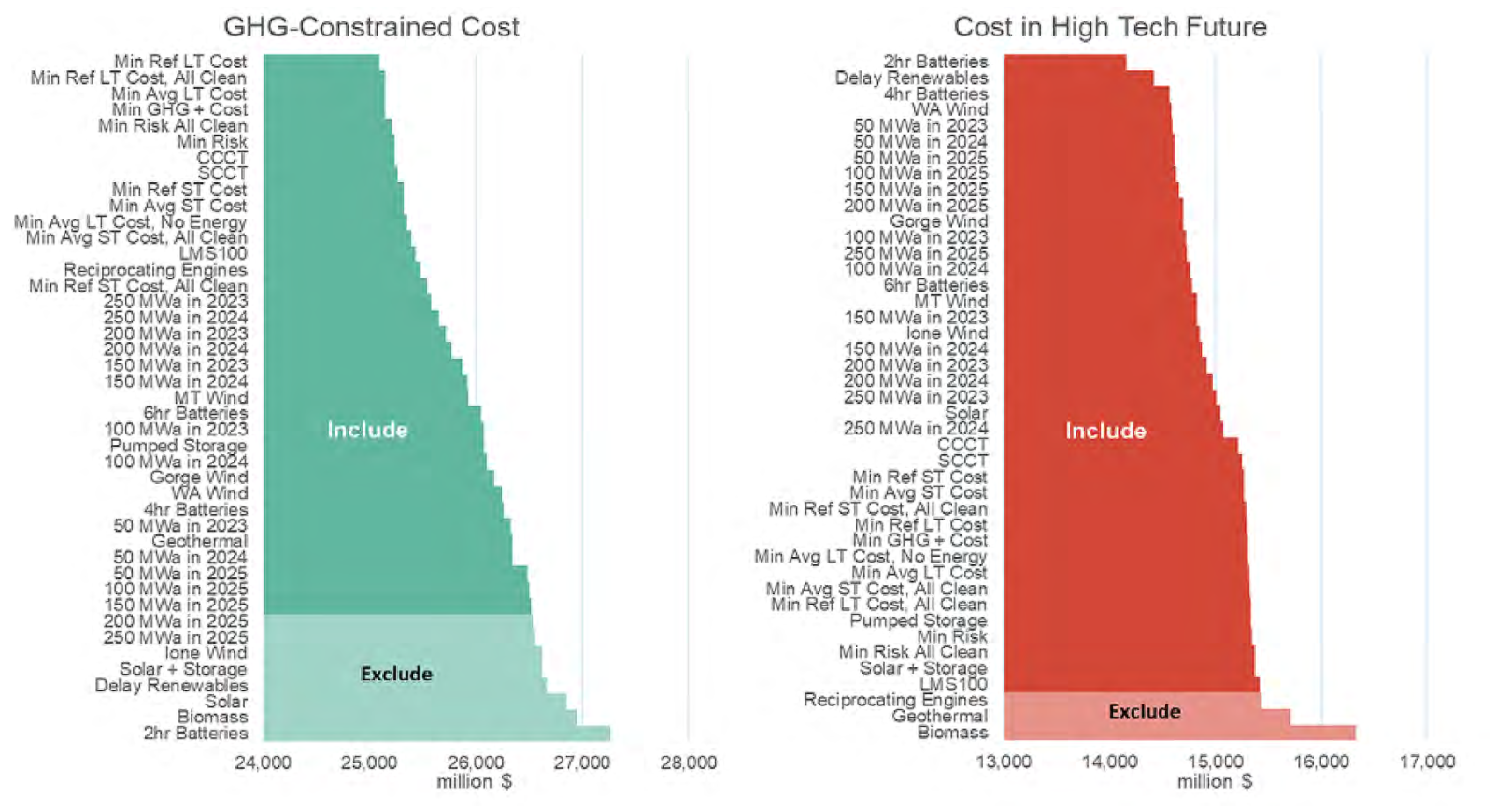
These were the main two future scenarios for which portfolio cost was graphically examined, but modelers also evaluated the performance of the candidate portfolios across a total of 810 possible futures. Using the results of these stress tests, decision-makers evaluated the portfolios in terms of their variability in cost across the scenarios, and severity, which measured performance in the highest percentiles of cost outcomes.
This methodology has the advantage of not needing to assign probabilities for future scenarios, avoiding a potentially contentious decision-making process. However, this can also be a drawback, as scenarios that are very extreme can unintentionally bias the results. For example, if there is a scenario in which all uncertain parameters take their worst-case value at the same time (for example, high fuel price, high resource costs, high load, and low hydro availability), this scenario might in reality be very unlikely, but it could bias the portfolio performance metrics. This tendency can be counteracted by only choosing scenarios that planners “reasonably” wish to plan for.
The second option for consolidating stress-testing results is to explicitly use probabilities to weight the different scenarios. This is known as stochastic analysis, and it is especially common in the context of running a Production Cost Model (PCM) for different variables such as fuel prices. A recent EPRI report covers stochastic analysis in detail,10 so we keep our discussion intentionally brief. The result of a stochastic analysis is a distribution of cost outcomes for a portfolio, allowing modelers to look at metrics such as average costs, or costs for a particular percentile. They can also use metrics such as Conditional Value at Risk to examine “tail” risk or performance in a set of worst-case scenarios.
Making decisions given stress-testing results
The advantage of a strong scenario analysis framework is that it gives decision-makers as much information about the future performance of portfolios as possible, to aid them in making decisions. Ultimately this will be a subjective process involving stakeholders and it is not possible to prescribe a one-size-fits-all approach. However, in this section we wish to highlight several important concepts that underlie good decision-making under uncertainty.
In general, an ideal portfolio will be one that balances near-term costs with expected risks. This concept is sometimes explicitly laid out in the rules governing IRPs in states such as Oregon, where the PUC’s IRP mandate states “the primary goal must be the selection of a portfolio of resources with the best combination of expected costs and associated risks and uncertainties for the utility and its customers.”11
Often, there will be some portfolios that minimize only near-term cost, and others that trade off increased near-term costs for lower long-term risks. These latter portfolios can be seen as an insurance policy: spending more in the near term, to reduce the risk of costs being much higher than expected in the long term. The right balance of near-term cost and risk is a delicate trade-off that will always be up to the decision-maker.
Two other concepts that can be helpful for decision-making are the idea of selecting a portfolio that minimizes downside risks (or worst-case performance), and the idea of selecting a portfolio that minimizes “regret,” which is the risk that infrastructure will be unneeded. These concepts can be flexibly incorporated into decision-making as appropriate.
Specific Roles of Key Entities
Scenario analysis, and the advanced methods that can be used within it, have the potential to be implemented across the utility space. Many entities have already implemented strong scenario analysis frameworks aided by heuristics, motivated by the need to develop more flexible and least-regrets portfolios. In this section, we aim to aid those looking to adopt scenario analysis and/or advanced uncertainty management methods by providing a summary of the key roles different entities could play during implementation:
-
Regulators and legislators
- Clarify that the goal of planning should not be just a “least-cost” plan, but rather a plan that balances expected costs with associated risks.
- Provide guidance on key uncertainties and/or stress tests to consider
- Specify types of methods to be adopted
- Ensure scenarios and uncertainties proposed are realistic
-
Utilities and/or load-serving entities
- Develop procurement plans using the scenario analysis framework, ensuring to include the stress-testing component
- Use advanced methods for developing flexible, adaptable near-term decisions when necessary
- Seek stakeholder input and understanding of the methods
- Emphasize the potential benefit of portfolios developed with advanced methods by showing the potential for reduced risk
-
System operators and/or transmission planners
- Adopt a two-step scenario analysis framework for transmission planning
- Consider using advanced methods such as stochastic and robust optimization, which can help to identify hard-to-find flexible and adaptable options
- Work with load serving entities to understand range of possible futures for load and resources; coordinate across processes if possible
Initial Steps Towards Integration in Planning
Many utilities and transmission planners already have adopted a strong scenario analysis framework. However, it is less common for planners to use advanced methods such as stochastic and robust optimization. Therefore, in this section we will both: 1) highlight entities that have adopted a strong scenario analysis framework, and 2) highlight entities that have gone further to use advanced stochastic and/or robust methods.
Examples of entities with strong scenario analysis frameworks
- MISO Long Range Transmission Planning. In MISO’s transmission planning process, planners identified a series of “alternatives”, or candidate transmission plans, along with a series of “futures”, or plausible scenarios that represent what the future could hold. Planners tested these alternatives across the range of futures to find a preferred plan.12
- ENTSO-e “e-Highway2050” transmission planning project. In the planning process of ENTSO-e, the entity responsible for international transmission planning in Europe, planners identified a series of scenarios, and performed deterministic modeling for each scenario. Planners then identified transmission projects which show up in multiple scenarios as most likely to be needed, which is an example of the “heuristics” method discussed in this paper.13
- California PUC Long Lead Time Resource Procurement. In California, most of the state is a deregulated electricity market, so there is no central planner. However, recent legislation mandated that the CPUC examine the potential benefits and costs of certain long-lead-time resources that load-serving-entities were not expected to procure, in support of possible centralized state procurement of these resources. The CPUC adopted a scenario planning approach to evaluating the need for these resources. They identified a range of procurement levels of the specified resources (the candidate plans), as well as an extensive set of future scenarios, and identified which candidate plans were likely to do well across a range of possible futures.14
Examples of entities adopting advanced uncertainty management methods
- Portland General Electric 2019 IRP. As extensively covered in this paper, in PGE’s 2019 IRP, planners used a scenario analysis framework paired with stochastic optimization for near-term portfolio development to determine a portfolio that appropriately balanced near-term costs with long-term risks.15
- Brazilian National System Operator Hydropower Scheduling. In Brazil, the majority of energy generated comes from hydropower, which introduces a scheduling problem: the dispatch of hydro assets must be determined under significant uncertainty about future operations and system needs. To solve this problem, the system operator uses a stochastic optimization model. Though this is a slightly different application from generation and transmission expansion planning, this methodology has been in use since 1998, making it one of the longest-running examples of using stochastic optimization for electricity planning.16
It is important to note that many other entities have extensively discussed adopting stochastic optimization into their planning processes; for example, MISO hosted a Probabilistic Planning Symposium in 2024 as previously cited. However, despite longstanding interest in these techniques, very few entities have implemented them into decision-making. A key barrier is the difficulty of assigning probabilities to future scenarios, which can be a difficult and fraught process. However, incorporating these methods into a scenario analysis framework, rather than seeing them as “one-and-done” tools for managing uncertainty, can be a helpful idea to reduce barriers to implementation.
Measuring Success
As important as knowing how scenario analysis and advanced uncertainty management methods work is knowing when they have been successfully implemented. In support of this goal we present a list of things to check for when evaluating an uncertainty management framework for utility planning. This list could be used by planners, regulators, stakeholders, or other parties:
- Clearly splits out the “portfolio development” phase from the “portfolio analysis” or “stress testing” phase. In the portfolio development phase, relevant “here-and-now” decisions are appropriately identified.
- Clearly identifies major sources of uncertainty to be considered.
- Identifies a broad range of near-term decisions, including those that are likely to be “least-regrets” or work well across a wide range of possible futures.
- Analyzes performance of near-term portfolios against a wide-range of possible futures.
- Identifies the potential for near-term decisions that may add cost, but help to reduce long-term risk.
- (Optional) uses stochastic or robust optimization to aid in developing near-term portfolios.
Remaining Gaps and Barriers to Implementation
As demonstrated by the example of PGE’s 2019 IRP, which represents a strong usage of both a scenario analysis framework and stochastic optimization, there are not any technical barriers to the implementation of the methods described in this paper. Rather, we believe the main barriers are more related to software and computation:
- Off-the-shelf software availability. Existing software tools commonly used in planning processes often lack the ability to implement stochastic and/or robust optimization.
- Ease of use of software. Even when features such as stochastic and robust optimization are implemented in planning software, they are frequently not easy to use, hindering their adoption. Additionally, current tools often do not make it easy to properly implement a scenario analysis framework.
- Computational constraints. Stochastic optimization, in particular, can be highly computationally intensive, potentially increasing runtimes past the realm of what is considered acceptable to modelers. This can be mitigated by smart scenario selection, and advanced algorithms currently being developed by researchers.
Key Takeaways
To close, we wish to highlight several key takeaways:
- Deterministic scenarios alone are not sufficient as an uncertainty management framework. Rather, to manage uncertainty, planners should adopt a framework of identifying possible near-term decisions, and then stress-testing them across many possible futures. This framework is known as scenario analysis.
- Advanced methods such as stochastic and robust optimization can be used to help planners identify near-term portfolios that are flexible, adaptable, and minimize long-term risks. These methods can help identify portfolio options that may not show up using traditional deterministic methods, particularly when the decision space is large.
- Heuristic methods that combine information from multiple scenarios can also be used to develop low-risk near-term decisions.
- The barriers to implementation of these methods are “soft,” not technical: these methods can be implemented without any new methods development, although software implementation remains a key barrier.
About This Report
Authors
Gabriel (Gabe) Mantegna and Roderick Go, Resilient Transition
Acknowledgements
We thank participants of the IRP CoLab advisory group and steering committee, with special gratitude to Elaine Hart and Priya Sreedharan for their input in IRP CoLab workshops and previous drafts of this report.
IRP CoLab steering committee
- Priya Sreedharan, Nikhil Kumar, Ric O’Connell, GridLab
- Tyler Fitch, Lauren Shwisberg and Gaby Tosado, RMI
IRP CoLab advisory group
- Austen Sharpe, Dazhong Xia, Catalyst Cooperative
- Nidhi Santen, Electric Power Research Institute
- Matthias Fripp, Energy Innovation
- Danielle Sass Byrnett, National Association of Regulatory Utility Commissioners (NARUC)
- Clayton Barrows, National Laboratory of the Rockies
- Harry van der Weijde, Max Parzen, Aisling Pigott, Open Energy Transition
- Ryan Tracey, Sonoma Clean Power
- Elaine Hart and Jaxon Stuhr, Sylvan Analytics
- Roderick Go and Gabriel Mantegna, Resilient Transition
- Aaron Schwartz, Telos Energy
Disclaimer
The views expressed in this document are of the authors alone and cannot be attributed to any other organization or individual.
Developed as part of the IRP CoLab emerging themes deep dive series and first published in February 2026. The original listing is available on IRP CoLab, and the full report can be downloaded as a PDF.
References
- MISO Probabilistic Planning Symposium, November 19, 2024. ↩
- The studies are: 1. Munoz et al (2014): “An Engineering-Economic Approach to Transmission Planning Under Market and Regulatory Uncertainties: WECC Case Study”. IEEE Transactions on Power Systems, Vol. 29, No. 1. 2. van der Weijde and Hobbs (2012): “The economics of planning electricity transmission to accommodate renewables: Using two-stage optimization to evaluate flexibility and the cost of disregarding uncertainty”. Energy Economics, Vol. 34. ↩
- See: Stenclik, Derek. “Rethinking the Role of Capacity Expansion Modeling: An alternative approach for reliable and economic portfolio design under uncertainty.” Telos Energy and GridLab. December 2024. ↩
- The use of representative periods, when implemented carefully, is technically an example of stochastic optimization, one of the methods discussed in this paper, that is specific to weather uncertainties. However, we prefer not to refer to it as such, to avoid confusion with stochastic methods that integrate other types of uncertainties. Sometimes, capacity expansion methods are described as stochastic, in the sense that they integrate a wide range of weather conditions, but it is important to understand that this is no different from well-established methods which use representative periods. ↩
- For further discussion of these methods and opportunities for potential improvement, see: 1. A. Burdick, et al. “Lighting a Reliable Path to 100% Clean Electricity: Evolving Resource Adequacy Practices for a Decarbonizing Grid,” IEEE Power and Energy Magazine, vol. 20, no. 4, pp. 30–43, Jul. 2022. 2. Hart, Elaine. “Iterative Portfolio Optimization: An essential tool for reliable and clean electricity planning.” Sylvan Energy Analytics and GridLab. December 2024. 3. Mantegna, G., et al. “Electric Grid Reliability in an Era of Unprecedented Uncertainty: A Review of Advances in Electric Sector Resource Adequacy Assessment and Planning.” IEEE Transactions on Energy Markets, Policy, and Regulation. December 2025. ↩
- See: ENTSO-E. (2015) “Europe’s future secure and sustainable electricity infrastructure: e-Highway2050 project results”. Available at: docs.entsoe.eu. ↩
- Taken from: “2019 Integrated Resource Plan”, Portland General Electric. ↩
- See: Mantegna, G. and Jenkins, J. “Transmission Planning Under Uncertainty for California.” Keynote presentation at Transmission Planning Summit, June 2025, Sacramento, CA. Peer-reviewed publication forthcoming; more details on the study are available in the Appendix of the following comments submitted to the CPUC in August 2025. ↩
- Taken from: “2019 Integrated Resource Plan”, Portland General Electric. ↩
- Electric Power Research Institute. “Stochastic Analysis for Electric Company Resource Planning: A Primer”. March 2025. Technical Brief. ↩
- Oregon PUC Order No. 07-002. 2007. Available at: apps.puc.state.or.us ↩
- See: MISO Long Range Transmission Planning ↩
- See: e-Highway2050 project results booklet ↩
- See: CPUC staff workshop on ALJ ruling on central procurement ↩
- See: Portland General Electric 2019 Integrated Resource Plan ↩
- See: M. E. P. Maceiral et al., “Twenty Years of Application of Stochastic Dual Dynamic Programming in Official and Agent Studies in Brazil-Main Features and Improvements on the NEWAVE Model,” 2018 Power Systems Computation Conference (PSCC), Dublin, Ireland, 2018, pp. 1-7, doi: 10.23919/PSCC.2018.8442754. ↩